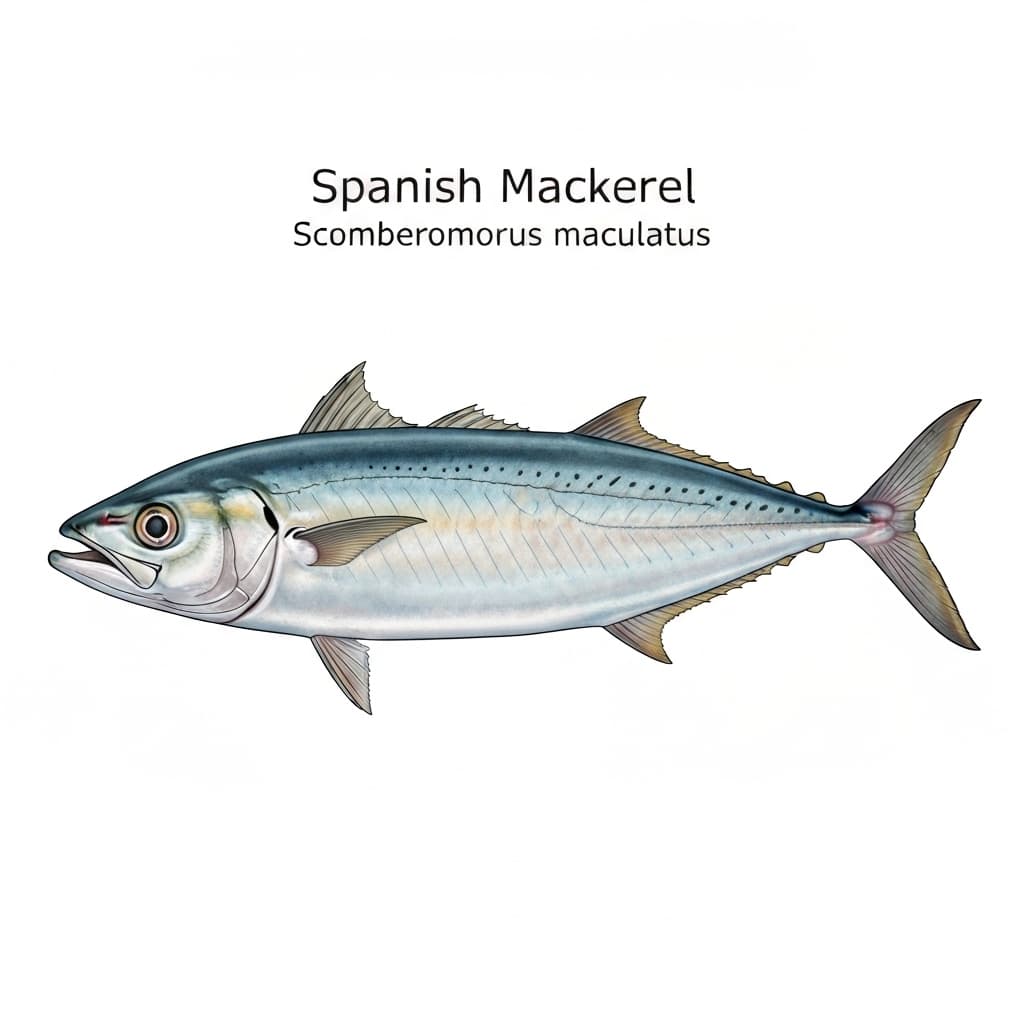
Spanish Mackerel scientific illustration

Spanish Mackerel

Scomberomorus maculatus

Mackerel

Why this fish matters

Spanish Mackerel is an important Gulf of America game fish. Anglers target it for a mix of food value, strong fights, and the fact that it shows up again and again in inshore and offshore trips. Knowing how to identify it quickly on the water helps you stay legal, protect the resource, and make smart keep-or-release decisions.

Quick identification snapshot

  • Body type: Typical of mackerel in the Gulf
  • Overall profile: Read from head to tail when you compare fish on a cleaning table or in photos
  • Primary ID focus: Head shape, tail shape, fin placement, and color pattern
  • Where you’ll see it: Common in Gulfport–Mississippi Sound trips and offshore runs out of the central Gulf
  • Key identification features

    Use these features together, not one at a time:


  • Body shape and thickness
  • Look at how deep or slender the body is, how it tapers toward the tail, and how tall the fish looks from back to belly.


  • Head, mouth, and jaw
  • Pay attention to snout length, jaw angle, and how far the mouth reaches (to the eye, behind the eye, or shorter).


  • Tail shape (caudal fin)
  • The tail can be rounded, square, slightly forked, or strongly forked with long points. That single detail separates a lot of Gulf species at a glance.


  • Dorsal fin layout
  • Count how many distinct dorsal sections you see (spiny vs soft), and whether the spinous portion is low and even, very tall, or broken into obvious sections.


  • Color pattern and markings
  • Overall tone (silver, brown, green, blue) plus any bars, spots, or stripes provide fast confirmation when combined with body shape.

    Common confusion points

    Around the Gulf Coast it’s very easy to mix up similar species on the dock:


  • Young fish in many families look more silver and generic than adults
  • Snapper and small grouper can be confused by color alone if you ignore body depth and head shape
  • Pelagic species (tunas, mackerels, and jacks) can blur together when they’re bled out in the fish box

  • When in doubt, slow down and compare head shape, tail, and dorsal fin layout before you rely on color.

    Habitat, behavior, and typical size

  • Habitat: Gulf of America waters commonly fished from Mississippi and nearby ports
  • Structure: Tends to relate to structure that matches its group: reefs, wrecks, ledges, rips, sand flats, or channel edges
  • Diet: Feeds mainly on smaller fish, shrimp, crabs, or squid depending on the group
  • Size range: Most fish that recreational anglers see are in the small- to medium-adult range, with larger trophy-class fish showing up seasonally
  • On-the-water ID tips

  • Take a clear side-profile photo as soon as you land the fish; it is much easier to ID a fish from that shot later.
  • Note where you were fishing (inshore bay, nearshore reef, or blue water) and how deep. Many similar-looking species separate cleanly by depth.
  • Check your state regulations app or booklet using both the common name and the scientific name if you are unsure.
  • Conservation and regulations

    Spanish Mackerel is part of a heavily fished Gulf fishery. Regulations change as managers react to new data on stock health.


  • Always confirm current size limits, bag limits, and seasons before your trip.
  • When you release fish, support the body horizontally, avoid touching the gills, and get them back in the water quickly.
  • For deep-water species, be prepared to use a descending device or venting tool if required by regulation.
  • Take-home

    If you remember nothing else about Spanish Mackerel, remember this:


  • Start with the overall silhouette (deep-bodied vs slender)
  • Lock in on head shape, tail fork, and dorsal fin layout
  • Use color and markings last as confirmation, not the only clue

  • That approach will keep you out of trouble on the dock and confident when you’re sorting a busy fish box at the end of a long Gulf trip.

    Want Spanish Mackerel fishing tips?

    Get seasonal reports, local hotspots, and identification tips for Spanish Mackerel and other Gulf species.

    FishingLarge proudly supports Mississippi Aquarium at Gulfport. Learn how you can help.

    FishingLarge independently supports Mississippi Aquarium at Gulfport. Mississippi Aquarium at Gulfport has not endorsed or sponsored FishingLarge.