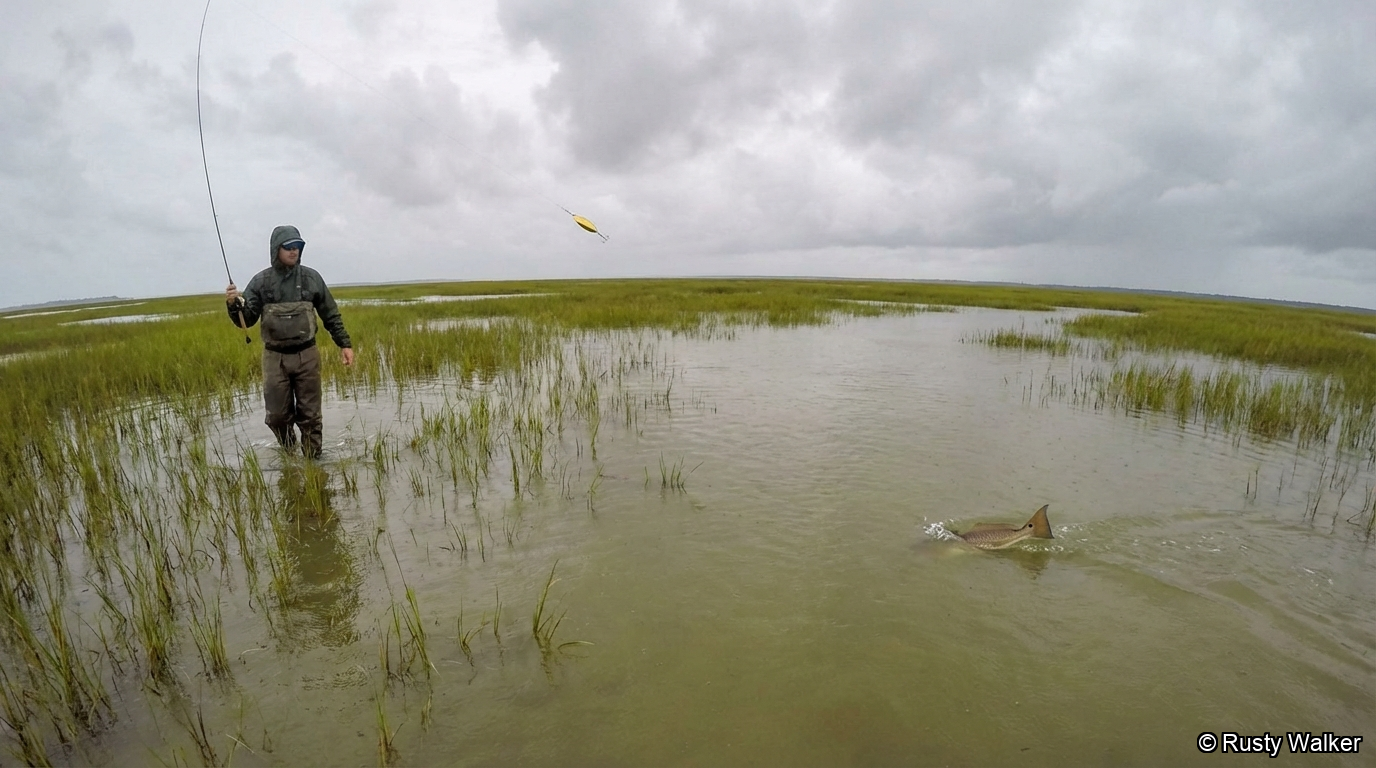
The Biloxi Marsh is a sprawling, labyrinthine world of broken islands, shallow ponds, and winding bayous. It is a place that both tests and rewards anglers in equal measure. For those who learn its rhythms, particularly the subtle pulse of the flood tide, it offers one of the most visually exciting challenges in saltwater angling: sight fishing for redfish in mere inches of water. While various tactics can prove effective, one method stands out for its elegant simplicity and raw effectiveness. The gold spoon, when presented correctly during a high and rising tide, becomes an irresistible offering to marsh redfish on the hunt.
This is not a numbers game or a matter of blind casting toward a shoreline. It is a calculated hunt, a game of stealth, observation, and precise execution. The strategy hinges entirely on understanding how redfish behavior changes when rising water grants them access to the "backcountry," the shallowest flats and spartina grass edges that are dry land on a low tide. Here, crabs, shrimp, and small baitfish become trapped, creating a temporary buffet for hungry predators. Our task is to quietly enter this shallow arena, locate these feeding fish, and present a simple piece of metal in a way that triggers a predatory strike. It is pure, fundamental angling that connects you directly to the environment and the fish.
This guide details our field-tested approach to mastering the flood tide spoon pattern in the Biloxi Marsh. We will cover the gear, the strategy for reading the water and weather, the critical nuances of boat positioning, and the specific retrieve that turns a simple spoon into a redfish magnet.
Understanding the Flood Tide Phenomenon
The entire pattern is built around the tide. Specifically, we are interested in the upper end of a rising tide, often referred to as a "flood tide." In coastal Louisiana, tides are often wind-driven and may not follow the predicted charts perfectly. A steady onshore wind from the southeast can push tides higher than predicted, creating prime conditions. Conversely, a strong north wind can blow water out of the marsh, canceling a promising tide before it even begins.
The key is water level. We are looking for a tide high enough to submerge the dense spartina grass lines and shallow mud flats that are typically exposed. This could be a predicted 1.5-foot tide or higher, but visual confirmation is what matters. As the water rises, it unlocks a new feeding zone. Redfish, with their underslung mouths and bottom-feeding nature, are perfectly designed to patrol these newly flooded areas. They will push into water that is often less than a foot deep, their backs and tails breaking the surface as they root around for crustaceans.
This window of opportunity is finite. The ideal time is often the last two hours of the rising tide and the first hour of the falling tide. During this period, the water is high, and the current is moving, which encourages bait to move and predators to feed actively. Once the tide turns and starts falling significantly, the redfish will pull back off these extreme shallows and reposition along the first available depth change, like a ditch or the edge of a bayou. Arriving too early means the fish have not moved in yet; arriving too late means they have already left. Success requires timing your trip to coincide precisely with this high-water event.
Gearing Up for the Marsh
Success in this environment demands tackle that favors stealth and accuracy over raw power. The casts are often short to moderate, but they must be precise and land softly.
**Rod and Reel:** A 7-foot to 7-foot, 6-inch spinning rod with a medium-light or medium power and a fast action tip is the ideal tool. This setup provides the backbone to handle a powerful redfish while offering the sensitivity and tip action needed to cast a lightweight spoon accurately. It allows you to load the rod with a flick of the wrist, which is essential when a quick, quiet cast is needed at a moment's notice. Pair this with a high-quality 2500 or 3000-size spinning reel with a smooth drag system. The drag is critical; these fish will make powerful, short runs in shallow water, and a jerky drag can easily pull hooks or break the line.
**Line and Leader:** The main line should be a 10- to 15-pound test braided line. Braid offers superior casting distance, sensitivity, and zero stretch for solid hooksets. Its thin diameter also helps it cut through any surface vegetation. At the terminal end, a 24- to 30-inch leader of 20-pound test fluorocarbon is essential. Fluorocarbon is nearly invisible underwater and provides much-needed abrasion resistance against oyster shells and sharp grass. Connect the braid to the leader using a reliable, low-profile knot like an FG knot or a modified Alberto knot to ensure it passes cleanly through the rod guides.
**The Weedless Spoon:** The star of the show is a 1/4-ounce to 3/8-ounce weedless spoon. Gold is the universally accepted top producer in the tannic, stained waters of the Louisiana marsh, as it perfectly mimics the flash of a small crab or baitfish. Copper can also be extremely effective, especially on cloudy days. The crucial feature is the weed guard. You will be casting directly into and over submerged grass, and a spoon without a good weed guard will snag constantly, ruining your presentation and spooking fish. The spoon should produce a distinct side-to-side wobble on a steady retrieve, a motion that sends out vibrations redfish can feel with their lateral line.
The Hunt: Tactics and Approach
With the right gear and an understanding of the tide, the hunt begins. This is where execution separates successful trips from frustrating ones.
**Boat Positioning and Stealth:** The single most important factor is stealth. These redfish are in a hyper-sensitive state in shallow water. Any unnatural noise, be it a slammed cooler lid, a dropped tool, or the hum of a trolling motor, will send them fleeing. The push pole is not optional; it is the primary tool for this style of fishing. A poling platform provides a huge advantage, giving you the elevation needed to spot fish from a distance and pole the boat with minimal effort.
Your approach should be planned from a hundred yards out. Determine the direction of the wind and, if any, the current. Position the boat upwind or up-current of the area you intend to fish. This allows you to make a long, quiet drift through the target zone. Use the push pole to make minor corrections and to silently stop the boat when a fish is spotted. The trolling motor should only be used for major repositioning in deeper water, well away from where you expect to find fish.
**Reading the Water and Identifying Targets:** You are looking for signs of life. The most obvious sign is a "tailing" redfish, where its tail fins break the surface as it feeds head-down on the bottom. Another key indicator is a V-wake, a subtle push of water created by a fish moving just below the surface. Sometimes, you will see "nervous water," a patch of agitated water that looks different from the surrounding surface pattern, indicating baitfish are being harassed from below.
High-quality, polarized sunglasses are mandatory. They cut the surface glare and allow you to see into the water. Look for the dark shapes of cruising fish, the orange glow of their fins, or the white flash of a mouth as they feed. Pay close attention to subtle differences in the marsh. Small points of grass, openings into smaller ponds, and areas with slightly deeper water (even just a few inches) are all natural ambush points that will hold fish.
**Casting, Presentation, and Retrieve:** Once a fish is spotted, the presentation is everything. Do not cast directly at the fish. This will almost always spook it. Your cast should lead the fish, aiming to land the spoon several feet in front of and beyond its location. The goal is for the lure to enter the fish's field of view naturally during the retrieve, not to land on its head. The spoon should land with as little splash as possible.
Let the spoon sink for a second or two, then begin a slow, steady retrieve. Hold your rod tip up at about a 10 o'clock position. This keeps the line off the water and grass and allows the spoon to wobble just over the top of the submerged vegetation. You are not trying to burn it back to the boat. You want a retrieve speed that is just fast enough to make the spoon wobble enticingly. You will feel the spoon's vibration through the rod. If you feel it tick the top of the grass, give the rod a slight, gentle pop to free it without yanking it out of the strike zone. The strike is rarely subtle. It is usually a violent thump, and your job is simply to reel tight and let the rod do its work.
Common Mistakes to Avoid
Many anglers struggle with this pattern because of a few recurring, easily corrected mistakes.
* **A Noisy Approach:** Being too loud is the number one reason for failure. Turn off radios. Put phones on silent. Do not slam hatch lids. Use the push pole and embrace the silence. * **Ignoring the Wind:** Failing to use the wind to your advantage makes boat control nearly impossible. Always set up a drift that lets the wind work for you, not against you. * **Casting at the Fish:** As mentioned, casting directly on top of a redfish is a recipe for a spooked fish. You must lead them and present the lure as an intersecting target. * **Retrieving Too Fast:** A common error is reeling the spoon too quickly. This causes it to rise to the surface and lose its action. The retrieve needs to be slow and steady to keep the spoon in the strike zone with the right wobble. * **Neglecting Leader Health:** The marsh is full of oyster shells. Check your fluorocarbon leader frequently for any nicks or frays. Retie your knot after every few fish to ensure you do not lose the fish of the day to a failed leader.
Safety and Regulatory Reminders
The Biloxi Marsh is a vast and wild place that demands respect.
* **Navigation:** It is incredibly easy to get lost in the marsh. A reliable marine GPS with up-to-date charts is essential. Have a backup navigation tool, like a smartphone app, and know how to use it. * **Hazards:** Be constantly aware of submerged hazards like oyster bars and mud flats, which can appear suddenly on a falling tide. * **Float Plan:** Always file a float plan. Let someone on shore know where you are going and when you expect to return. * **Regulations:** You must have a valid Louisiana saltwater fishing license. Be familiar with the current regulations for redfish, including the daily bag limit and the slot size limit. Responsible angling means keeping only what the law allows and releasing all other fish carefully.
The Captain's Word
This guide outlines a proven system for targeting Biloxi Marsh redfish on the flood tide. It provides a solid foundation of tactics that will put you in a position to be successful. However, it is important to remember that this is just one approach. Professional charter captains who spend hundreds of days a year in this ecosystem have their own highly refined techniques and deep knowledge of specific areas. When you hire a licensed captain, you are paying for their expertise. Always defer to your captain's judgment. Their on-the-water decisions are made with one goal in mind: to put you on fish safely and effectively.
The thrill of poling across a flooded flat, spotting a tailing redfish, and making the perfect cast is an experience that stays with an angler. The gold spoon pattern is a testament to the idea that sometimes the simplest methods, when applied with skill and understanding of the environment, are the most potent. It is a challenging hunt, but the reward is a close-quarters battle with one of the Gulf Coast's most iconic gamefish in its most beautiful element.