The hum of the diesel engines settles into a low thrum, the only constant sound in a world that has shrunk to the pool of light on our deck. Out here, more than eighty miles from the Louisiana coast, the darkness is absolute. The distant glow of a floating oil platform on the horizon serves as our only landmark, a man-made star in the vast blackness of the Gulf of Mexico. This is the offshore arena south of Venice, and we are here for one of the most powerful and sought after predators in the ocean: the yellowfin tuna.
Venice, Louisiana, earned its reputation as a world-class fishing destination for a simple reason: geography. It is the last outpost of civilization before the Mississippi River Delta dissolves into the Gulf, providing the quickest access to the deep, blue water where pelagic giants roam. The underwater canyons and the thousands of oil and gas platforms create a unique, nutrient-rich ecosystem. These structures act as vertical reefs, attracting baitfish and, in turn, the apex predators that hunt them. At night, this hunt takes on a new dimension, and the technique of chunking becomes a deadly effective strategy.
Chunking is a method of creating a consistent trail of cut bait to draw fish to your boat. While it sounds simple, doing it correctly under the cover of darkness for monster yellowfin is a disciplined art form. It requires patience, precision, and a deep understanding of the currents and the fish. It is a game of tempting unseen leviathans, turning the water behind your boat into a feeding lane that leads directly to your hook.
Gearing Up for the Midnight Bite
Success in this environment begins long before the first piece of bait hits the water. Your equipment must be flawless and capable of handling extreme pressure. This is not the place for light tackle.
A proper setup starts with a stout conventional rod, typically in the 6-foot range, with a heavy or extra-heavy power rating. This is necessary for lifting and controlling a large tuna during the grueling final stages of the fight. Pair this rod with a high-capacity two-speed conventional reel. Reels like a Penn International 50W or a Shimano Talica 50 are trusted standards for their powerful drags and line capacity. Spool these reels with at least 600 yards of 100 to 130-pound braided line. The thin diameter of braid allows for more line on the spool and less resistance in the current, a critical factor when a tuna makes its initial blistering run.
The terminal tackle is where preparation meets opportunity. The connection from your mainline to your leader is crucial. A well-tied Bimini twist or a wind-on leader system provides a secure, streamlined connection. From there, a heavy ball-bearing swivel is attached to prevent line twist. The leader itself is a subject of constant debate, but a 6 to 8-foot section of 80 to 150-pound fluorocarbon is a good starting point. This is the first of many moments where you must rely completely on your charter captain's judgment. An experienced Venice captain will assess the water clarity, moonlight conditions, and the behavior of the fish to determine the ideal leader size. Their call overrides any textbook recommendation, as a leader that is too thick may spook wary tuna, while one that is too thin will part under strain.
Finally, the hook must be up to the task. A 7/0 to 10/0 heavy-gauge circle hook is the best choice. These hooks are designed to catch the fish in the corner of the mouth, resulting in a more secure hookset and a healthier release if the fish is not a keeper. Make sure your hook points are incredibly sharp.
The Art and Science of the Chunk Line
With the boat positioned and the gear ready, the main event begins. The goal is to establish a drift that carries your boat and your scent trail over promising structure or temperature breaks. Again, this is where a captain's expertise is indispensable. They will use their deep knowledge of the area, combined with advanced electronics, to set up the perfect drift angle and speed, factoring in wind and current. This decision alone can be the difference between a quiet night and nonstop action.
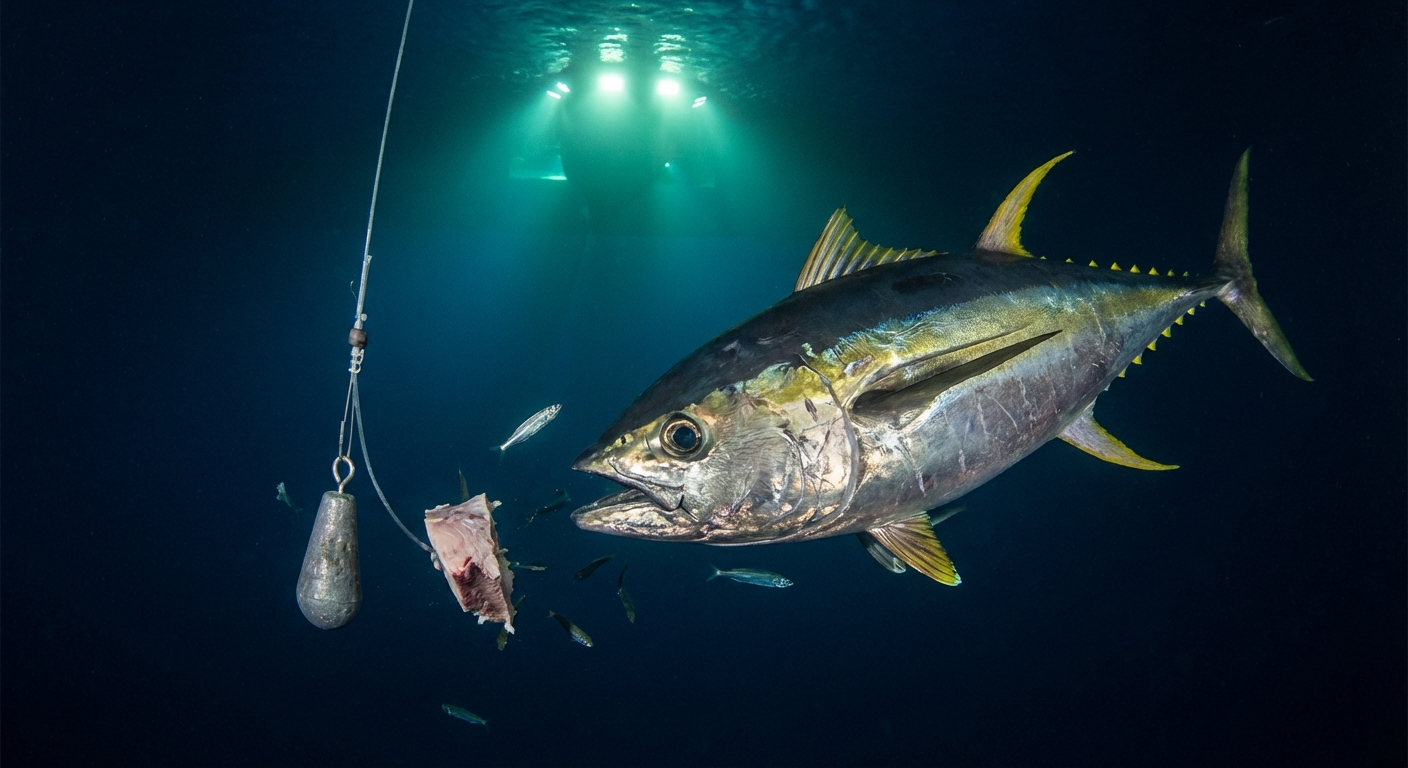
The bait is the star of the show. While various baits can work, frozen blocks of threadfin herring or fresh blackfin tuna are preferred. A dedicated crew member will begin methodically cutting the bait into uniform, bite-sized pieces, about one to two inches square. Consistency is key. Every 30 to 45 seconds, a small handful of these chunks are dropped into the water. This steady cadence creates a continuous underwater conveyor belt of food that yellowfin can track from a distance.
One of the baited lines is deployed with a chunk hooked to drift as naturally as possible alongside the free offerings. The reel is left in freespool with the clicker on, allowing the line to pay out at the same speed as the sinking chunks. The angler must be vigilant, letting line out manually to ensure there is no drag or tension that would make the hooked bait behave differently from the others. A yellowfin will often test a bait subtly, and any unnatural resistance will cause it to drop it. The take can be a soft click, click, click of the reel or an explosion as the fish inhales the bait and tears off into the darkness.
The Fight After Sundown
When a yellowfin commits, there is no mistaking it. The clicker's sound turns into a sustained scream as hundreds of yards of line disappear from the spool in seconds. The initial run is a test of the reel's drag system and the angler's composure. The key is to let the fish run, maintaining steady pressure, before pushing the drag lever up to strike position. The circle hook will do its job, setting itself firmly.
The fight is a battle of endurance. A big tuna will use its body shape and powerful tail to circle deep below the boat, a stubborn, back-and-forth tug of war. The angler must use proper technique, bending at the knees and using their whole body, not just their arms, to pump the rod and gain line. The boat's crew will be in constant motion, clearing other lines and maneuvering the boat to help the angler keep the line away from the hull and engines. After what can feel like an eternity, the fish's circles will become smaller and tighter as it tires. When its silver and yellow form finally appears in the boat's lights, the moment of truth arrives. The crew will be ready with a gaff to secure the prize.
Common Mistakes to Avoid
The path to landing a Venice yellowfin is filled with potential missteps. Anglers new to the technique often make a few common errors. 1. **Inconsistent Chunking:** Throwing too many chunks at once or waiting too long between offerings breaks the scent trail and confuses the fish. Discipline is mandatory. 2. **Unnatural Drift:** Not letting line out fast enough puts drag on the hooked bait, making it look suspicious to an approaching tuna. It must look identical to the free chunks. 3. **Impatience:** Anglers often get excited and engage the drag too early, pulling the hook out of the fish's mouth before it has fully taken the bait. Wait for the fish to turn with the bait before coming tight. 4. **Ignoring the Captain:** This is the most critical mistake. Your captain might tell you to switch to a smaller bait, change leader size, or prepare to move. Their instructions are based on years of experience and subtle cues you may not notice. Trust their authority completely. A captain’s call to abort a trip due to a sudden change in weather is not a suggestion; it is a command that ensures everyone's safety.
Safety, Regulations, and Respect
Offshore fishing, especially at night, carries inherent risks. Always know the location of safety equipment on the vessel, including life vests and the EPIRB. Pay close attention to the pre-trip safety briefing. Weather can change in an instant, so professional crews are constantly monitoring conditions.
Fisheries regulations are also a serious matter. Bag limits, size limits, and species regulations are in place to ensure the health of the fishery for future generations. Before you leave the dock, have a direct conversation with your captain about the current federal and state regulations for yellowfin tuna and any other species you might encounter. These limits change, and your captain will have the most up-to-date information for the day.
Landing a yellowfin tuna by night chunking is one of the pinnacle experiences in saltwater angling. It is a demanding and technical challenge that pushes gear and anglers to their limits. It is a perfect blend of raw power and refined technique, set against the mysterious backdrop of the deep, dark Gulf. The reward, a hard-earned tuna on the deck, is a memory that will last a lifetime.