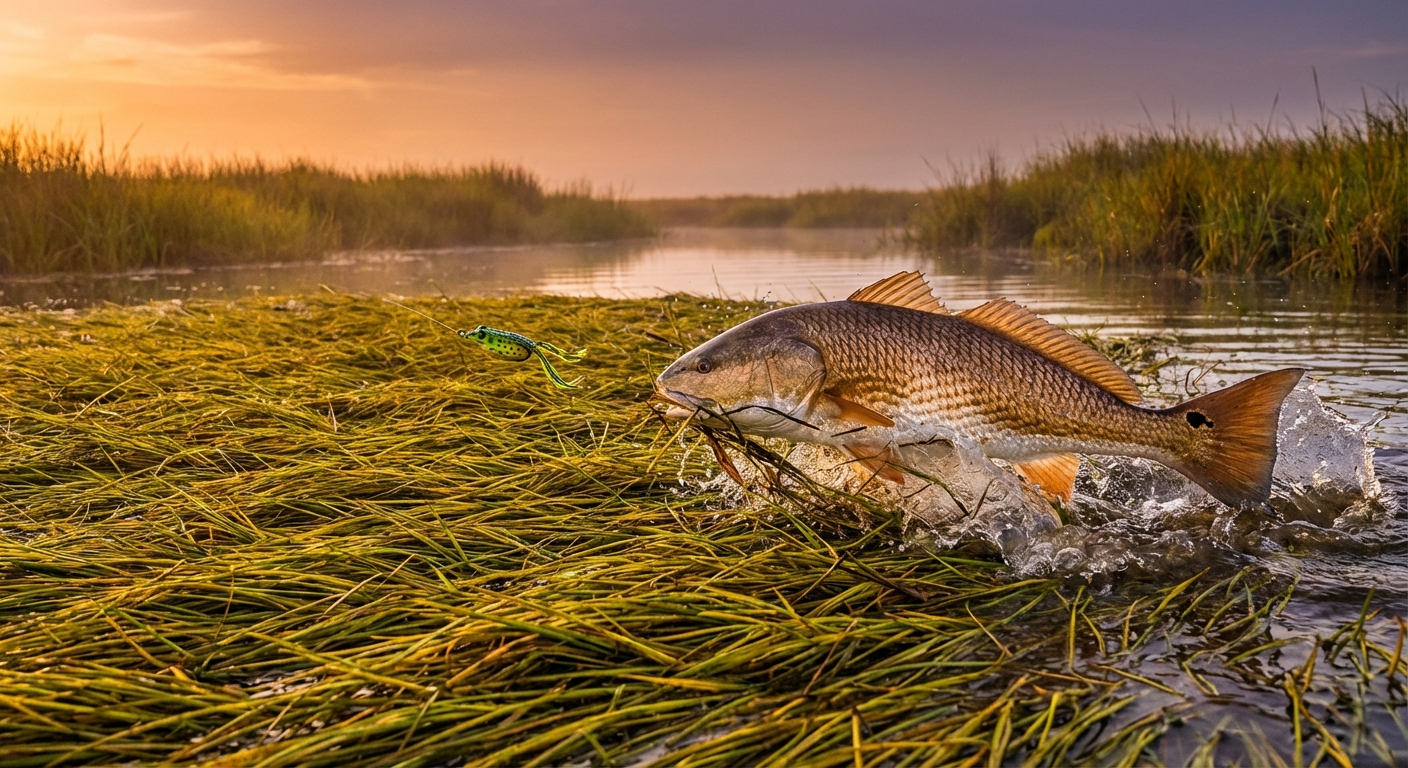
The air in south Louisiana during the summer is thick enough to swim through. On Calcasieu Lake, the sun beats down with an intensity that drives anglers to seek shade and an early end to the day. But for the lake’s most prized inhabitants, the redfish, this oppressive heat offers an opportunity. As the water temperature climbs, vast, floating mats of widgeon grass and coontail become floating sanctuaries. They offer shade, cooler water, and a perfect ambush platform. For the angler willing to brave the conditions, these grass mats hold some of the most aggressive and explosive redfish action available anywhere on the Gulf Coast. The key to unlocking it is not a shrimp, a spoon, or a popping cork. It is a weedless, hollow-bodied frog.
Fishing topwater frogs over matted vegetation is a technique borrowed from the freshwater bass world, but it is brutally effective on the bronze-backed predators of Big Lake. It is a physically demanding, visually stunning, and technically precise way to fish. The strikes are not subtle taps; they are violent, heart-stopping explosions as a broad-shouldered redfish detonates through the green canopy. Mastering this approach requires specific gear, a deep understanding of tidal patterns, and a healthy dose of patience at the moment of truth.
The Logic of the Mats: Why Redfish Move In
Understanding why redfish bury themselves in these seemingly impenetrable grass beds is the first step toward catching them there. It is all about survival and opportunity. The dense overhead cover provides significant relief from the sun, creating a layer of cooler, more oxygenated water beneath. This is a simple matter of comfort.
More importantly, the mats are a buffet. Blue crabs, shrimp, and finger mullet use the grass for their own protection. Redfish, with their superior power and underslung mouths, are perfectly designed to patrol the edges and push deep into the cover to root out these meals. They will carve out small patrol zones, using the grass as both a pantry and an ambush point. An unsuspecting mullet straying too close to the edge or a crab scuttling across a small opening is an easy meal. Your frog, presented correctly, mimics this vulnerable prey perfectly. They are not just hiding from the sun; they are actively hunting.
Timing the Bite: Tides, Current, and Weather Windows
Success in the Calcasieu grass is dictated by water movement and light conditions. Arriving at the wrong time means casting over empty, stagnant water. A savvy angler treats the tide chart and weather forecast as essential tools.
Tidal movement is the single most important factor. A falling tide is generally the most productive period. As water pulls out of the surrounding marsh, it forces baitfish and crustaceans into the main lake, concentrating them along the grass lines. The redfish know this. They will position themselves on the down-current edges of the mats and points, waiting for the conveyor belt to deliver their next meal. Look for areas where the current is constricted, creating a distinct flow along the vegetation. This is a prime ambush location.
A high and stable tide can also be productive, but it presents a different scenario. The fish may push deeper into the heart of the mats, making them harder to reach. In this case, focus on any potholes, breaks, or isolated clumps within the larger mat. A cast that lands in a small opening surrounded by dense grass is often irresistible to a nearby redfish.
Weather and light conditions create specific windows of opportunity. Overcast, cloudy days are a gift, as they can extend the bite throughout the day. The lower light emboldens the redfish, making them more likely to roam and feed aggressively. On bright, sunny days, the classic low-light periods of early morning and late afternoon are paramount. The first hour after sunrise and the last hour before sunset are when you will find the most action. A light chop on the water can help conceal your presence, but heavy wind makes it nearly impossible to work a frog correctly and detect strikes. Calm to light-wind days are ideal.
Gear for Heavy Combat: The Right Tools for the Job
This is not finesse fishing. Attempting to fish the mats with standard inshore tackle will lead to frustration and lost fish. The gear must be robust enough to execute a powerful hookset, withstand the shock of a close-quarters strike, and then physically haul a powerful fish out of thick vegetation.
**Rod and Reel:** A 7-foot to 7-foot-6-inch casting rod with a medium-heavy or heavy power rating and a fast action tip is the required tool. The length helps with long casts, while the heavy backbone provides the leverage needed to pull a redfish from the grass. Pair this with a high-quality baitcasting reel. A higher gear ratio, such as 7.1:1 or faster, is advantageous for quickly picking up slack line before the hookset. A strong, smooth drag is non-negotiable.
**Line:** There is no room for compromise here. Fifty to 65-pound test braided line is the only choice. Monofilament or fluorocarbon will stretch on the hookset, failing to drive the hooks home. Lighter braid will break when it wraps around thick grass stalks. The zero-stretch, high-strength nature of heavy braid is essential for setting the hook and controlling the fish.
**Lures:** Hollow-bodied frogs are the weapon of choice. Lures like the Strike King KVD Sexy Frog or the Spro Bronzeye Frog are proven performers. Color selection can be kept simple. Natural green patterns, solid black, and solid white are all you need. In clear water, natural colors excel. In stained water or low light, the silhouette of a black or white frog is easier for the fish to track. Experienced charter captains will often trim the rubber-strand legs of the frog to give it a tighter walking action, a small modification that can make a significant difference.
The Tactical Approach: Boat, Cast, and Cadence
With the right gear, the focus shifts to execution. Your approach to the mats must be stealthy and precise. Use a trolling motor to quietly parallel the edge of the grass line, keeping the boat a long cast away. This prevents your hull slap and shadow from alerting the fish to your presence.
The cast is critical. You must cast the frog *onto* the mat, not just up to the edge. Let it land softly a few feet into the grass. Let it sit there for a few seconds. A redfish holding nearby will often react to the initial landing, and this pause gives it time to locate the source.
The retrieve, or cadence, is what brings the lure to life. Use short, downward snaps of the rod tip to make the frog "walk" back and forth. The goal is a rhythmic side-to-side sashay. The most effective cadence is often a walk-walk-pause rhythm. Twitch the rod twice, making the frog dart left then right, and then let it sit still for two to three seconds. Most strikes occur during this pause. The frog appears as a stunned or injured creature, an easy target. Vary your cadence until you find what the fish want on that particular day.
Pay close attention to visual and auditory cues. Watch the edges of the grass for wakes or "V's" pushed by cruising fish. Listen for the distinct "pop" of redfish feeding under the canopy. Any sign of life deserves several casts.
The Strike, The Hookset, The Win
The topwater explosion is one of the most exciting moments in fishing, but it is also where many anglers make a critical error. Your instinct upon seeing the water erupt is to immediately snatch the rod back. You must fight this instinct.
When a redfish strikes, it often boils on the lure or throws it without getting the hooks. If you set the hook on the splash, you will pull the lure away from the fish nine times out of ten. Wait. After the initial explosion, reel down quickly until you feel the weight of the fish. When the line comes tight and you feel the heavy pressure, that is the moment for the hookset. Point the rod at the fish, and then use a long, sweeping set, using your whole body, not just your arms.
Once hooked, the fight is a contest of leverage. The redfish’s first instinct is to dive back into the thickest grass it can find. Do not let it. Keep your rod tip high and apply maximum pressure to steer its head up and away from the vegetation. This is where the heavy rod and braid earn their keep. Get the fish into open water, and the fight is yours to win.
Common Mistakes and How to Avoid Them
- **The Premature Hookset:** Again, wait until you feel the weight of the fish. Say "one-one-thousand" to yourself after the strike before setting.
- **Underpowered Gear:** Using light line or a medium-action rod will result in poor hooksets and broken lines. Commit to the heavy tackle.
- **Fishing Only The Edges:** Do not be afraid to cast deep into the mats. Redfish will often hold far from the edge, and a lure working its way out is a powerful trigger.
- **No Pauses:** A continuous retrieve is far less effective. The pause is when the redfish commits. Make it a core part of your cadence.
Captain guidance, safety, and regulations
These tactics are a strong baseline, but your charter captain should always have final say on gear adjustments, positioning, and cadence for that day’s conditions. Good captains adapt quickly to wind shifts, water clarity changes, and fish mood, and that local judgment is often the difference between a slow day and a productive one.
Always be familiar with the current Louisiana fishing regulations, including slot size and daily bag limits for redfish. Practice proper fish handling. If you plan to release fish, do it quickly to minimize stress. On the water, keep sun protection and hydration dialed in, and stay courteous around other boats working the same zones.
The Calcasieu grass mats offer a unique and challenging arena for targeting redfish. It is a game of power, precision, and nerve. For those who invest the time to learn the patterns and master the technique, the reward is an unforgettable topwater experience, a true clash with the mat monsters of Big Lake.