The Power of the Jig in Destin
Destin’s nearshore artificial reefs are legendary grounds for red snapper. While dropping live or cut bait is a proven method, anglers looking for a more active and often more productive approach are turning to vertical jigging. This technique allows you to cover the entire water column, trigger aggressive reaction strikes, and present an offering that stands out from the crowd. A well worked jig often selects for larger, more dominant fish. Success, however, is not about random dropping and ripping. It is a technical discipline that requires a deep understanding of boat positioning, electronics, and technique.
Reading the Water: Current and Positioning
Before you even drop a jig, your success is determined by how you position the boat. The most important factor on any reef is the current. Your goal is to present the jig to fish that are staging on the up-current side of the structure, waiting for bait to be pushed to them.
First, motor well up-current from the reef structure you intend to fish. Use your GPS and sonar to mark the structure’s precise location. Stop the boat and observe your drift track and speed. This initial drift tells you everything. You need to know how the current and wind are moving your boat over the bottom. Your goal is to drift your jigs directly over the structure, not away from it.
The decision to anchor or drift depends entirely on the speed of this current. If the current is slow, under one knot, a controlled drift is often best. A slow drift allows you to present your jig across different parts of the structure, prospecting for the most active fish. If the current is faster, anchoring is almost mandatory. A fast drift will pull your lines at a sharp angle, making it impossible to keep your jig in the strike zone. Anchoring allows you to hold your position up-current and surgically drop jigs back to the fish.
Sonar is Your Window to the Reef
Your sonar is your underwater eyes. As you approach the reef, you are not just looking for a generic pile of fish. You are looking for specific marks and how they are positioned. Red snapper will typically appear as thicker, more distinct marks, often holding just above the structure. They will look like stacked arches or dense clouds of red and yellow on your screen.
Pay close attention to where the fish are holding. Are they tight to the top of the wreck? Are they suspended 20 feet above it? Are they concentrated on one specific edge? This information is critical. It tells you exactly where to position the boat and at what depth to concentrate your efforts. If the fish are high in the column, you may not need to drop your jig all the way to the bottom, which can save you from costly snags.
Gearing Up for the Vertical Battle
Vertical jigging for powerful reef fish like red snapper demands specialized gear. You cannot get by with a standard bottom fishing rod.
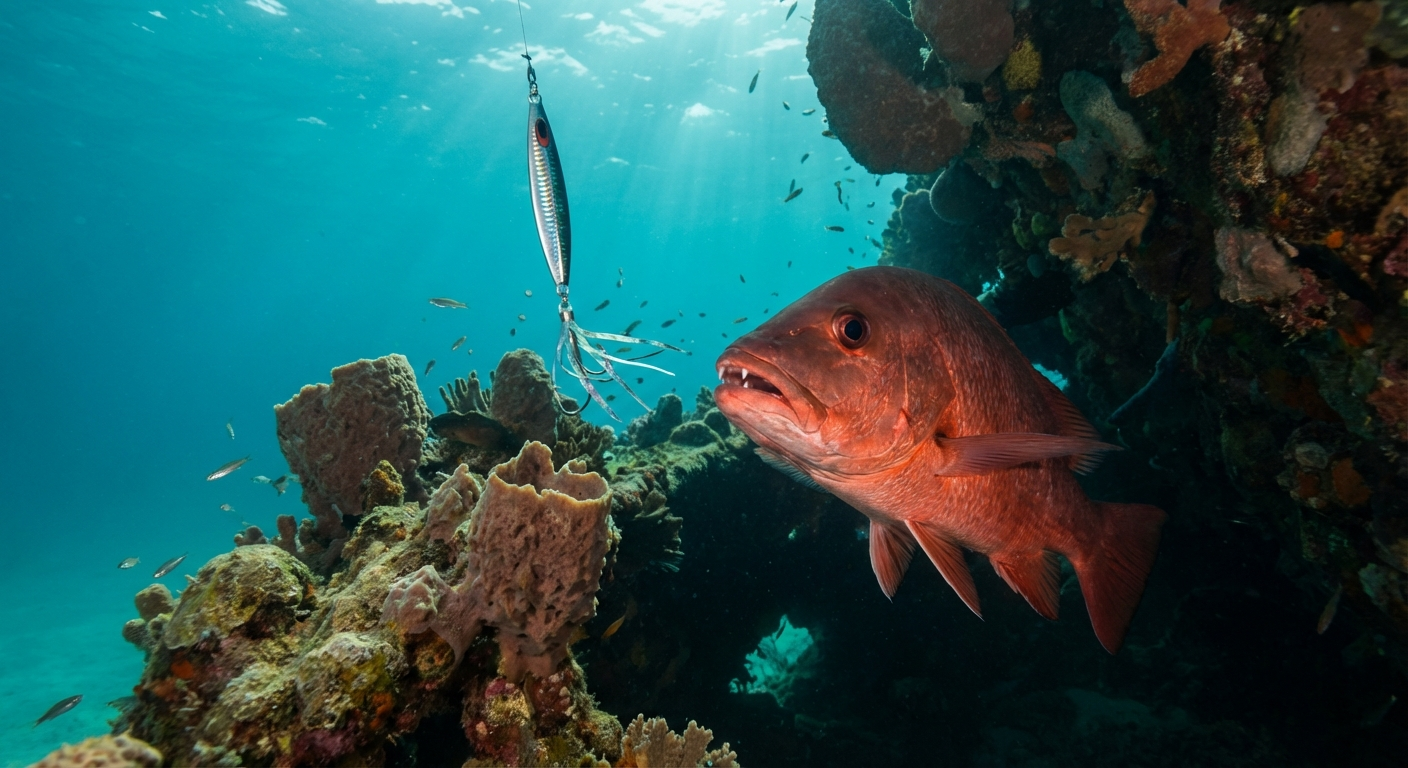
* **Rod:** A 6-foot to 7-foot conventional rod with a fast action is ideal. The short length provides leverage, while the fast tip allows you to impart the correct sharp, snapping action to the jig. * **Reel:** A high-speed conventional reel with a gear ratio of 6.0:1 or higher is crucial. You need to be able to pick up line quickly after a long drop and keep pressure on a fast-running fish. * **Line:** 50 to 80 pound braided mainline is the standard. Braid has near-zero stretch, which is essential for feeling the subtle bites and setting the hook effectively in deep water. It also has a thin diameter, allowing your jig to drop faster and more vertically with less scope. * **Leader:** A 6 to 8 foot section of 60 to 80 pound fluorocarbon leader is necessary. It provides abrasion resistance against the reef structure and is less visible to the fish. * **Jigs:** Jig weight is dictated by depth and current. The rule is to use the lightest jig you can while still maintaining a vertical line angle and feeling the bottom. In most Destin nearshore scenarios, from 80 to 150 feet, jigs from 4 to 8 ounces will cover most situations. Knife jigs and long, slender jigs are excellent for a fast drop, while wider, fluttering jigs can be effective when fish are less aggressive.
The Art of the Drop and Work
With the boat positioned correctly, it is time to send the jig down. The most common mistake is having too much angle, or scope, in your line. You want your line to be as close to perfectly vertical as possible. A severe line angle kills the action of the jig and dramatically reduces your ability to detect a bite.
Drop the jig to the bottom, but control the descent with your thumb on the spool. Many strikes happen on the fall, and if you are not in contact with your jig, you will miss them. Once you feel the jig hit bottom, immediately engage the reel and retrieve one or two cranks. This prevents your jig from snagging on the structure.
The working action is a "lift and fall" motion. Use a sharp upward lift of the rod, from the 9 o’clock to the 11 o’clock position, followed by a controlled drop. As the jig falls, follow it down with your rod tip to stay in contact. Most strikes will feel like a sudden weightlessness or a sharp tap as the jig descends. Reel down fast and set the hook hard.
Troubleshooting the Bite
Sometimes the fish are finicky. You may see them on the sonar but cannot get a solid hookup. These short strikes, where fish just nip at the tail of the jig, can be frustrating.
* **Change Jig Size or Color:** Sometimes a smaller profile or a different color is all it takes. * **Add an Assist Hook:** If you are using a jig with only a tail hook, add a free-swinging assist hook to the top eyelet. This will often hook the short-strikers. * **Pause Your Cadence:** Instead of a constant rhythm, let the jig pause and hang motionless for a few seconds during your retrieve. This can trigger a hesitant fish to commit. * **Jig vs. Bait:** If you have marked fish on the sonar that refuse to eat a jig after multiple attempts, it may be time to send down a live bait. There are days when even the most aggressive snapper prefer a natural presentation. Do not be too stubborn to switch when the conditions call for it.
Landing and Releasing for a Healthy Fishery
Once you hook up, the fight is on. Keep steady pressure and use short, powerful pumps of the rod to lift the fish away from the structure.
When a snapper is brought up from deep water, it may show signs of barotrauma, such as a bloated stomach or bulging eyes. Responsible anglers must be prepared to release fish safely. A descending device is a critical piece of equipment. These tools, which clip onto the fish's jaw, use a weight to rapidly send the fish back down to its home depth, allowing it to re-pressurize and giving it the best chance of survival.
Common Mistakes to Avoid
* **Too Much Scope:** Fishing with your line at a 45-degree angle is the most common error. Reposition the boat or use a heavier jig to stay vertical. * **Fishing Slack Line:** Always maintain contact with your jig, especially on the fall. * **Ignoring Electronics:** Do not fish empty water. Trust your sonar and focus your efforts where you mark fish. * **Dull Hooks:** Reef fish have tough mouths. Your hooks should be razor sharp. Check them frequently and sharpen or replace as needed.
Safety and Regulations
Red snapper seasons, size limits, and bag limits are strictly enforced and can change from year to year. Always check the most current regulations from the Florida Fish and Wildlife Conservation Commission (FWC) before you head out. Be aware of your position and stay within the state or federal water boundaries that apply to your fishing license and the current season.
Trust Your Captain
This guide provides a solid framework for vertical jigging Destin’s reefs. However, nothing replaces the on-the-water experience of a local charter captain. They fish these waters daily, understand the nuances of each individual reef, and know what the fish are responding to on any given day. Their knowledge is your greatest asset. Listen to their guidance, and you will be well on your way to a successful day on the water.